Showing posts with label off the shelf. Show all posts

Monday, June 6, 2011

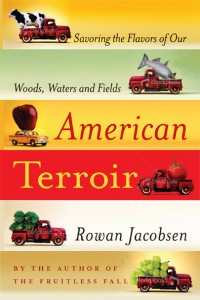
Off the Shelf: 'American Terroir'

"Savoring the Flavors of Our Woods, Waters and Fields" is the subtitle to this book, which focuses on food grown in specific (mainly) North American regions.

Author Rowan Jacobsen takes us on a food journey starting in Vermont, telling of why the land is able to produce the finest maple syrup. In each chapter, he not only describes the product, but also tells why and how the land is able to produce such a food -- and why it is not duplicable to other areas. 

For instance, coffee grown in Panama is so good because it is grown at such great heights, with the thin air making the beans denser, more refined with flavor. And the higher it's grown, the better. And since coffee trees can't survive at temperatures below 40 degrees, there's a limited space for them to grow. The tropics -- Panama included -- is one of those spaces.

The other chapters cover apples and cider from Yakima Valley in Washington state; honey varietals from New England, North Carolina and other coastal states; moules frites from Prince Edward Island; forest gastronomy from Quebec; oysters from Puget Sound; avocados from Mexico; salmon from Alaska; wines from California; cheese from Vermont; and chocolate from Mexico.

(I have to admit, I was a little disappointed that the author covered Vermont cheese and not Wisconsin cheese, but I can attest that I've had some great Vermont cheese.)

This book is as much about the land in (or on or under) which the foods grow as it is about the foods themselves. 

Monday, March 28, 2011

Off the Shelf: 'The Vertical Farm'

Photo courtesy of Vertical Farm
Off the Shelf is an occasional feature wrapping up a book about a food-related topic. These are not reviews; think of them as extended book jackets with important pull-out points.

Farming is a difficult venture. Water, weather, fertilizers, fossil fuels, disease, pests, agricultural runoff. All of these issues affect how the planet will be able to sustain human life in this century.

"The Vertical Farm: Feeding the World in the 21st Century" by Dickson Despommier addresses these issues and more.

He notes that as the population grows, to feed that population, an area the size of Brazil would have to be used as farmland.

Instead, Despommier posits that vertical farms can help to feed that growing population. Those vertical farms would be founded in urban centers.
Photo courtesy of Milwaukee Journal Sentinel

The farms he envisions would make optimal use of sunlight, reuse water and other plant waste, and decrease miles food would travel from farm to table. (In Milwaukee, Growing Power and Will Allen have already announced plans for a smaller version of a vertical farm.)

But Despommier admits that animal husbandry, by large, will need to remain out of the urban environment. There are some exceptions, of course.

There certainly are benefits to a vertical farm. Indoors would allow for year-round farming, limit weather- and pest-related crop failures, and allow for some farmland to be restored to its natural use.

There are a lot of upsides to a vertical farm. Unfortunately, the barriers to getting many implemented are money and politics. The idea is great; but can these farms become a reality?

Wednesday, February 16, 2011

Off the Shelf: 'For All the Tea in China'

Courtesy of SarahRose.com
Melissa and I enjoy tea a lot. We love making sun tea in the summer and we enjoy a good cup every now and then. That's why I decided to read "For All the Tea in China: How England Stole the World's Favorite Drink and Changed the World" (by author Sarah Rose) when I saw it at the library.

Really, the book is about Robert Fortune, an English explorer who was tapped to export tea and tea-making procedures from China to then England-held India, where English companies could reproduce the techniques and export the tea for mass profit.

Fortune was sent to China in 1848, and as part of his trip, he had to go undercover as a Chinese man past territories where foreigners were forbidden. He had to hire servants to assist him and guides to lead him.

The East India Company sent him and offered an enticing deal: The company wanted only the tea; Fortune could keep anything else he came across, including grasses, seeds, seedlings, flowers, fruits and ferns.

After months in China collecting tea samples and tea-making techniques, Fortune still had to overcome the problem of shipping fresh products on the ocean, where they would remain for months. He eventually thought he had found a solution to that problem and sent the first shipment to India and the Himalayas, where the plants would be grown.

Part way there, another freelancer for the East India Company confirmed that the plants looked well and had made the months-long journey. But by the time the plants arrived in the Himalayan stop, they had been decimated, the result of a worker opening the supplies before they had reached their destination.

A small fraction of the plants made it, but in poor shape, and the rest were dead, resulting in the devastating loss of a year of work by Fortune.

Despite the setback, he was eventually able to successfully transport enough tea plants and techniques from China to India to de-monopolize China's tea production.

One thing I didn't know? That the first cup of tea was for demons or "enemies." That's because the tea was often processed on the ground, allowing dust and other particles into the tea.

Wednesday, December 29, 2010

Off the Shelf: 'My Empire of Dirt' by Manny Howard

Courtesy Mannyland.wordpress.com
Off the Shelf is an occasional feature wrapping up a book about a food-related topic. These are not reviews; think of them as extended book jackets with important pull-out points.

Manny Howard was a writer who was tasked with living off of only what his farm could produce for a month, and he details his experiences in "My Empire of Dirt: How One Man Turned His Big-City Backyard into a Farm."

The book did not go into as much how-to as I thought it would, but Howard does a good job telling the stories behind the farm, including the book-long fight with his wife over the endeavor.

As interesting as Howard's adventures of creating a farm in an 800-square-food backyard are, perhaps the most interesting thing in the book is a layout of the farm on the title page. It shows the Back Forty -- the garden, in essence -- as well as the aviary tower, FEMA trailer and more.

Among the anecdotes Howard peppers through the book is one that crushed his vegetable garden. A tornado ripped through his New York City neighborhood and destroyed much of his garden. Likewise, he had quite the time with his rabbits and fish and, well, most everything.

The book is, at times, a litany of failure after failure. But the one area in which his farm succeeded was with his laying hens. Those hens helped wean the family from buying eggs for one year, and they often had more eggs and gave them away to friends and family.

As someone who has grown interested in raising backyard chickens, it's that part that is encouraging.

Monday, June 28, 2010

Off the Shelf: 'The Town that Food Saved'

Off the Shelf is an occasional feature wrapping up a book about a food-related topic. These are not reviews; think of them as extended book jackets with important pull-out points.

After reading "The Town that Food Saved: How One Community Found Vitality in Local Food," I felt that the subtitle was a more appropriate title than the actual title. Indeed, it did not seem as though food saved the community of Hardwick, Vt. Rather food seemed to be a common thread that led to the community being revitalized.

But I digress. It's a book worthy of a read, especially if, like me, you wonder whether a true local food movement would work in the Milwaukee, Wis., area (or the area where you live).


The author, Ben Hewitt, describes several older and younger people in the Hardwick area and the roles they have filled and the businesses they have created. He tells how all those people add up to create a food-centric community that has added to the revitalization of the area.


Those companies: High Mowing Organic Seeds, Highfields Center for Composting, Pete's Greens, the Center for an Agricultural Economy, Heartbeet Lifesharing, Vermont Soy Company, Vermont Natural Coatings, Jasper Hill Farm, Claire's. There are other farms and farmers, too; this is not a be-all, end-all list.


And now, the hail of bullets:

  • the author says "sustainable" has been corrupted: "At its core, agriculture is a human manipulation of a natural process. Is there a version of agriculture that is truly sustainable? Probably so. Is there a version of agriculture that is truly sustainable and able to feed 7 billion people? Almost certainly not."
  • talking about the decrease in the number of farmers: "Every step toward diluting the farming population among us is another step toward food insecurity."
  • a decentralized agricultural system will force us to think differently about how we shop and about what we eat.
  • Hewitt, who has a farm, on the value of food: "... the value of the food we grow isn't the food minus the labor necessary to bring it to the table. It is the food plus the labor."

Tuesday, April 20, 2010

Off the Shelf: 'Goat Song' by Brad Kessler

I had heard of Brad Kessler before, but I had never read a book written by him before "Goat Song: A Seasonal Life, A Short History of Herding, and the Art of Making Cheese."

So when I saw this book in the library, I was immediately intrigued.

I expected it to be a bit more heavy-handed with information, but it was quite breezy and conversational in tone. The book is broken up into parts, and the middle part is perhaps the most intriguing.

It features a diary-like presentation with each page denoting one day with Kessler's thoughts on the day as well as how much goat milk was produced (and often why: to wit, if production was down, he would not a goat was not feeling right, or something of that sort) and notes on some of the cheeses he tried to make from that milk.

The other parts focused on buying mountain land in the Northeast and about his and his wife's travails in setting up a goat farm and the process of going through it. Later in the book, the author wrote about his trip to France and his attempts to mimic the goat-cheese-making process from that area.

Thursday, March 25, 2010

Off the Shelf: 'Righteous Porkchop' by Nicolette Hahn Niman

Off the Shelf is an occasional (OK, very occasional) feature wrapping up a book about a food-related topic. These are not reviews; think of them as extended book jackets with important pull-out points.

"Righteous Porkchop: Finding a Life and Good Food Beyond Factory Farms" by Nicolette Hahn Niman is divided into a few distinct sections. In the first, she details her work for Waterkeeperand its legal battle against factory farms; she focused mainly on hog farms. The second part (which is in the middle and near the end), focuses on Niman's focus on the Niman Ranch. And the third part focuses on other animals, including cows, fish and more.

The most interesting part of the book is the first part, during which the author describes her work at Waterkeeper. She travels to several states, visiting factory farms and goes on an expedition in North Carolina along the rivers and in the sky, viewing those farms from a different angle.

The other interesting part of the book was after she married Bill Niman, the co-founder of Niman Ranch. She wrote about how she wanted to be of greater use around the farm and how that spurred her education.

"Cow" was one thing that intrigued me. On farms, the word is used specifically to refer only to mature females who have given birth and weaned at least one calf. In other words, it's not a generalized term for all bovines.

And now, the hail of bullets:
  • The U.S. bans the use of growth hormones in poultry and pork, but not in beef
  • Pfiesteria piscicida organism, a result of excess nutrients in the water after liquefied manure seeps into water, "liquefies fish flesh while giving off dangerous vapors"
  • With the increase of mass-production farming, for egg-laying chicken breeds in many areas starting in the 1930s, many newborn chicks were simply killed since they would be of no use
  • In late 1998, after a hog market crash, the cost to raise was greater than the cost to sell, so many were simply throwing newborn pigs into manure lagoons to avoid raising them
  • Slaughterhouse byproducts are often ground up and sold to factory farms, which use them as a feed for other hogs and bovines
  • Niman visited a couple of Wisconsin farms, she writes [I should make clear that these were farms she visited that had good practices; these are not factory farms]; Bert and Trish Paris of Belleville and the Klessigs family farm (fellow Wisconsin food blogger Jeanne Carpenter has written about the Parises and about the Klessigs here, here and here)

Monday, August 31, 2009

Off the Shelf: 'American Vintage' by Paul Lukacs

Who doesn't love wine? It's great with a meal, without a meal or as a meal. And it's wine that is the subject of Paul Lukacs' "American Vintage: The Rise of American Wine."

His tale begins with Nicholas Longworth, who settled in Cincinnati in 1803. Eventually, he owned the first commercially successful winery in the U.S. He wanted wine to be a tool to forge an agrarian republic, living off the fat of the land. What I found interesting -- and it certainly makes sense in hindsight -- is that wine was the main or only use of grapes in the early 1800s.

Later, leading up to Prohibition, wine was used in taverns as a liquor. It's interesting to see that that perception has changed and that wine is now viewed more familial and less as a liquor.

Prohibition, unsurprisingly, shrunk the number of commercial wineries, from about 1,000 before to about 150 after. The Depression saw the industry change as speculators began to populate it by buying on the cheap and then ramping up production. Without that care to the product, it didn't help to enhance wine's image.

But Prohibition has left a stamp on the industry in other ways, too. For example, inter-state laws and regulations prove heady for some wine producers and fine wine advocates. Washington had a law to protect its wines, but a lot of wines grown in the state in the mid-1900s were cheap and, well, awful.

In 1966, Robert Mondavi left Charles Krug to start his own company. Before I started getting into wine and learning more about it, those were probably the only two names I could recognize. It's interesting to note how interconnected the California wine industry was in the 20th century.

Like a lot of other industries, it's interesting to note how commercialized the wine industry is. Coca-Cola, Pillsbury, Nestle and Schlitz Brewing are just some of the corporations that have owned a piece of the wine dollar. Nestle helped to breathe life into the Beringer label.

Boutique wines began to rise, and they began with Chardonnay. The varietal quickly became the before-dinner cocktail alternative.

Wine tended to rise with that of American cuisine. And regionally, one of the dishes mentioned in the book is sour cherry soup. I've heard of it in passing, and certainly never tried it. But the mention of it made me want to taste it some day.

Later, terroir (French for place in different senses: geographically, geologically, meteorologically, for some) began to creep into the industry. It's interesting because that certainly dovetailed in with the themes from Longworth and his ideals for wine in the early time of wine in America.

And wine has its own overseeing board, the American Viticultural Area, which I had never heard about.
  • And Julia Child note: "While Betty Friedan and Gloria Steinem were telling American women to get out of the kitchen, Julia Child showed them how to change their role in it." I just thought that was a great way to put her influence on American cooking.
Saturday, August 1, 2009

Off the Shelf: 'The Foie Gras Wars' by Mark Caro

I've never eaten foie gras. And Melissa hasn't either. So it's a bit difficult to throw myself into the middle of the controversy surrounding the delicacy as described in "The Foie Gras Wars: How a 5,000-Year-Old Delicacy Inspired the World's Fiercest Food Fight."

Basically, it boils down to whether you think gavage -- the term for force feeding the ducks or geese -- makes the animals suffer during the force-feeding period. The author, Mark Caro, a longtime Chicago Tribune reporter, talks to people on both sides of the issue, including restauranteurs and farmers who perform the gavage as well as animal-rights activists and others who say the process should be stopped.

One nuance that continues to come up is that those who opposed the force feeding often never visited a foie gras farm. And they also were inclined to say that foie gras farms would just give them the "white glove" treatment -- show them the clean processing areas -- if they did go to one.

The author describes his trips to some foie gras farms in America and France. He ate his fair share of foie gras, but he also participated in the foie farm process.

A foie gras liver can grow to be up to 6 to 10 times larger than a normal size one, which those against point to as unhealthy. In addition, they say that the animals vomit after feeding, but others posit that it is simply food from the force feeding that the duck or goose does not digest.

The question comes down to whether you think the animals suffer, either during the force feeding or in their treatment during the gavage period.

For me, the book certainly intrigued me enough to want to try foie gras sometime. And, if I do like it and see myself eating it a lot, to also visit a foie farm.

There were some larger issue pull-away quotes or passages that also intrigued me in the book:
  • "I think something good has to be coming from a farm that you recognize, with farming practices that you recognize. ... Gourmet has to be linked to sustainable farming." - Ariane Daguin, the daughter of famed French foie gras farmer Andre Daguin.
  • In the first few paragraphs of the second chapter, the author talks about the "collective denial" of not linking a living animal to be a part of the food that we eat. I think that is an apt term for that disconnect.

Sunday, July 5, 2009

Off the Shelf: 'Tuna: A Love Story' by Richard Ellis

Yep, it's a book about tuna. More specifically, though, it's a book about the bluefin tuna, one of the largest tuna species in the world. (The author does touch on other tuna species.)

Although Melissa and I don't eat a lot of fish or seafood -- less than we should, actually -- it was interesting to read about some of the intricacies of the fishing trade.

One of those was revealed in the first chapter, which dealt with Port Lincoln in Australia, where the modern tuna fisheries really exploded. Individual transferable catch quotas were designed to allow fishers to leave without losing a ton of money by transferring their catch quotas to another company in exchange for cash. Instead, what happened is a few companies ended up with a majority of the catch quotas, thereby dominating the industry.

Also in that chapter is the description of the "humane" way in which tuna are usually killed: Tuna are in pens and are shoved up a ramp onto a boat where someone grabs it by the gills and hauls it partially out of the water. Then a metal spike is shoved into its brain. And, of course, a different rod is plunged into its backbone so the fish meat does not tense up, thereby spoiling it.

Other killing methods include isolating a tuna so they can be shot by riflemen or are hauled out of the water and cut, allowing them to bleed out.

But much of the book delves into how bluefin are overfished and are loosing stock each year. For instance, fishers used to think that bluefins on each side of the Atlantic were separate species, but scientists who tagged fish found that they can swim from the American Atlantic seaboard to the Mediterranean. Fishers used to fish both stocks and think their numbers were separate, but since that was proved false, it means those bluefins are being over-fished even more than they were before.

In addition, some of the largest bluefin are being caught. That could be bad because it seems as though the larger bluefins have a higher chance of having their eggs successfully hatched, meaning catching the bigger fish could reduce the chance of bluefin re-population. Or the rate of re-population at the very least.

Some species of tuna are thought to seek shelter from dolphins and other sea creatures. Because of this, some fishers hunt for packs of dolphins to find tuna, which means some dolphins end up being caught when fishermen are trying to catch tuna.

Ultimately, the main reason these fish are being caught in abundance is the inclination of the Japanese diet, which places a high value on tuna sushi and sashimi.

And my favorite quote was from Barbara Block, who christened tuna "the cocaine of the sea."

Friday, June 19, 2009

Off the Shelf: 'It Must've Been Something I Ate' by Jeffrey Steingarten

In case you didn't notice, I write about food a fair amount. But I also read about food a lot. And one of my favorite food authors is Jeffrey Steingarten, who was a trained lawyer, but switched careers to become Vogue's food critic. I recently finished reading his second collection of essays, "It Must've Been Something I Ate."

The book opens with an essay about tuna, and Steingarten goes on an expedition to catch tuna in the Ensenada.

In "Salt Chic," he had a salt taste test by dissolving some table salt in water in a cup and then have the tester try to match that to one of two other cups: one with the same salt solution and one with a chic salt solution.

The next essay, "Fear of Formaggio," is about his experience sitting next to a woman who was pulling Parmesan curls from her salad. The audacity of that woman! Throwing away Parmesan should not be allowed.

He talks about his adventures trying to buy pig's blood in "It Takes a Village to Kill a Pig."

One of my favorite essays in the book, "Red Wine and Old Roosters," is when Steingarten delves into the classic French coq au vin recipe. I've never had it, but have always wanted to try it, especially since it appears quite a bit on cooking shows and the Food Network. He found at least one restaurant that had used female birds instead of a rooster, or coq. At the end of that chapter, he includes recipes for bouillon, marinade and coq au vin.

Steingarten tackles a bevy of other foodstuffs and topics: bread, chocolate, restaurant lines, gratins, caviar, espresso, pizza, sea urchin.

But my favorite sentence in the book came from "It Takes a Village to Kill a Pig" and I agree with his assessment on our connection to the food we eat:
"We shouldn't think of meat as something that originates in shrink-wrapped packages at the supermarket and imagine that we can escape the karma of killing by paying someone else to do it."
If you like this book, you should try his other book, "The Man Who Ate Everything."

Thursday, May 7, 2009

Off the Shelf: 'Chocolate' by Mort Rosenblum

(Off the Shelf is a series of book overviews, not reviews, that provides a synopsis of the book plus some of the more interesting tidbits gleaned from the book.)

"Chocolate: A Bittersweet Saga of Dark and Light" by Mort Rosenblum

In this book, Rosenblum digs into a subject near and dear to the hearts of many: Chocolate. From the Mayans and Aztecs, to the French, to the Ivory Coast, the author provides in-depth looks at some of the people who are a part of the worldwide chocolate trade.

A few of the chapters weren't as interesting to me, including the chapter about some French chocolatiers, but I did at least scan over them.

But there were a few of the chapters that were really intriguing and offered some insight on chocolate. The chapters delving into the history of chocolate in North and South America and its transfer to Western Europe were informative about the Mayan and Aztecs. Also, the chapter about cacao growing in the Ivory Coast was a good read, too, and discussed accusations about slave trade in the chocolate industry in that country.

Fun facts:
  • Godiva Chocolatier is owned by Campbell Soup Co.
  • mole (pronounced mo-lay), which I had thought was a chicken dish with a chili-based sauce and chocolate, actually called for wild Mexican turkey when it was first made